Workflow automation in practice


Using AI is common. Building it into a process and proving a measurable result is what companies now hire for.
Prompting got me through university, but building AI into a real business process, and answering for the result, is what got me responsibility. My name is Maximilian Schätzle and I study business administration at WU Vienna. As a working student at a consulting boutique, I was handed a task nobody owned yet: identifying and implementing where AI could add significant value in the firm’s daily work. Over the previous year, I built a governed compliance workflow on an enterprise AI platform and measured what it saved. Here is what that taught me about the skills companies now look for in early-career hires.
In just a few years, AI has gone from nice-to-have to an expected business standard in most German companies. According to the Bitkom Research 2026 survey, most of the German companies are using AI tools on a regular basis. This share rose from 36% to 57% in a single year, underlining a clear trend of AI adoption in business and showing that using AI is no longer a differentiator, but a baseline expectation for employees.
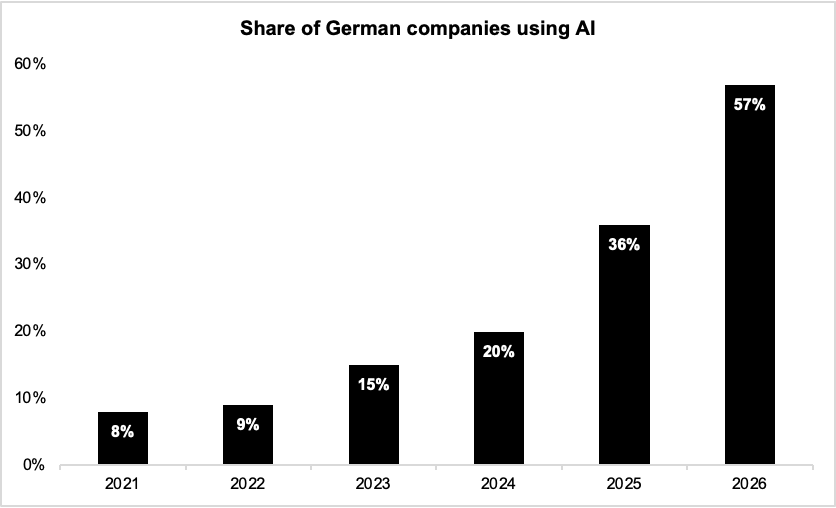
As adoption becomes the norm, access to AI stops being the scarce resource. What remains scarce is the ability to implement it in a work process that is secure, traceable and has a proven value to the company. That is where early-career hires can set themselves apart, and where university practice and professional reality diverge.
At university, AI is a personal tool. It runs in a second window, costs little or nothing and operates without governance or audit trail. Nobody reviews what goes in or what comes out; a question is asked, an answer is received, and the work ends there.
In a company, the same model sits inside a central platform with admin roles, enforced data protection rules and a traceable record of every request. On top of this, teams build workflows that run a process from start to finish, and AI agents that take over parts of complex tasks the way a colleague would: they gather information, prepare a decision or complete the task entirely.
The decisive difference is integration. These workflows are connected to core systems such as CRM records, mailboxes or calendars. They read from them and write results back when for example a customer record is updated, a mail is drafted or a meeting is scheduled. Many outputs therefore change something other people work with, and whoever builds or uses the workflow is accountable for the outcome and its safety.
The difference thus lies less in the model than in the framework around it. Anyone starting a career in this environment therefore needs more than just the perfect prompt.
Newsletter
Clear updates on what AI can do right now and how it affects your work. Every new piece lands in your inbox the day it's published. Free, and you can unsubscribe anytime.
What this framework demands are four skills. None of them depends on prompt engineering or on experience with a specific model. AI tools will change quickly but an appropriate framework holds regardless of whether Langdock or another platform is in use by tomorrow.
1. Breaking processes down into steps suited to AI: Break the whole process into single steps and decide for each one whether it becomes a workflow node handled by an AI agent, by code or by a person. Repetitive, rule-based steps, such as matching client names against sanctions lists, suit automation. Steps that need judgement, such as the final decision whether to accept a client, stay with a human. Two classic tools help: an entity relationship model shows which data objects are involved and how they relate (client, project, list, hit), and a process flowchart makes the sequence of steps transparent.
2. Governance thinking instead of mere tool operation: Governance means deciding in advance who may access which data, what a workflow may read and write in connected systems and what is logged. Without these rules, results cannot be traced or owned. That is why workspace structure, roles and traceability determine the benefit more than any prompt and secure a safe work environment for AI applications.
3. Critical review: AI output sounds convincing even when it is wrong. Results have to be classified and checked: which errors occur often and which have serious consequences. The final human check is planned from the start, with a defined person, a defined checkpoint in the process and the information needed to decide.
4. Stakeholder communication: It is the most underestimated skill, because the technical part rarely decides whether a workflow is adopted. The Managing Director, the back office and third parties each had different expectations and concerns, e.g. time and cost, changed daily work or compatibility with compliance regulations. A workflow works once each of them sees what it does for them and where their responsibility stays.
None of these skills goes out of date with the next model release, and that is exactly what makes them valuable. Taken together, they describe the profile companies are looking for in early-career hires. This is someone who can take a process nobody has automated yet, break it down, build it into a governed workflow, check what it produces, show what it saves and bring the people involved along. Knowing a tool is the entry ticket. Being able to add measurable value is what earns responsibility.
Go deeper
Learning material built with practitioners, structured chapter by chapter, for readers who want to work through a topic instead of reading about it once.
The following case illustrates how these skills operate in a real organizational setting. It draws on a project built on Langdock, a Berlin-based enterprise platform for AI applications that I worked with over the course of one year. The platform provides centralised access to language models and allows teams to build workflows and agents that are integrated into existing company systems. It is used by more than 13,000 organisations, including Merck, Unicef and Personio, and is listed on the German federal government’s AI marketplace, which points to its suitability for regulated and public-sector contexts.
The project originated at Radial, a finance consulting boutique focused on private equity clients, where I worked as a working student. At a firm of this size there was no AI strategy defined from above, only a task that nobody owned. Our Managing Director had recognised early that the competitive pressure to adapt to AI was increasing but lacked the capacity to address it himself. I was therefore tasked with assessing the potential of AI and identifying where it would be of concrete use to the firm.
New clients have to be screened against sanctions lists, a classic KYC/AML obligation. At Radial this used to be manual: client data was scattered across emails and documents, new project folders were created one by one, the back office checked the names against the lists and organigrams individually, documented the result by hand and cleared the case on individual judgement. This process is structured and rule-based, but document-heavy, error-prone when handled manually and a drain on time in daily project work. Tasks like this are well suited to workflow automation, as long as a human keeps the final decision.
The newly established AI workflow consolidates the new client data in a structured form, screens it automatically against the sanctions lists and drafts requests to the client for missing information, which a person approves before they are sent. Every step is logged, and a person checks plausibility before clearing the case.
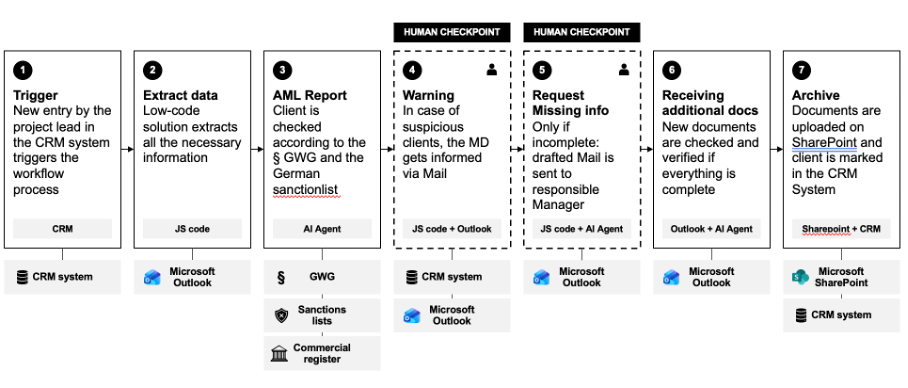
The manual effort per new client fell by about 95% per case and the remaining share is deliberate. The approval of drafted client requests and the plausibility check before clearing a case stay with a person.
The workflow also avoided an external purchase. An IT service provider had quoted around EUR 10,000 for automating this process. Instead, I built a solution on our existing Langdock platform myself, over a few months alongside my studies.
This is what measurable value and governance look like in practice. Time is saved, costs are avoided and human checkpoints that review the critical steps of the workflow are established.
Companies do not need more people who can write a clever prompt. They need people who can take a process nobody owns, make it work with AI and answer for the result. That takes no computer science degree: AI helps with the technical part, but the structure and the final check remain human work. What counts is the framework of breaking the process into steps, setting the rules, checking the output and bringing the people involved along. For early-career hires, this means three things: think in processes instead of prompts, check AI results instead of simply adopting them, and offer to take responsibility where nobody on the team owns AI yet.
The prompt gets you an answer. The framework gets you the responsibility.
Your link has expired. Please request a new one.
Your link has expired. Please request a new one.
Your link has expired. Please request a new one.
Great! You've successfully signed up.
Great! You've successfully signed up.
Welcome back! You've successfully signed in.
Success! You now have access to additional content.